
Effortlessly schedule and share shifts with RotaPlanner.app
Start with a 14-day trial.
What is the DuPont Shift Pattern
 By Kieran - Founder
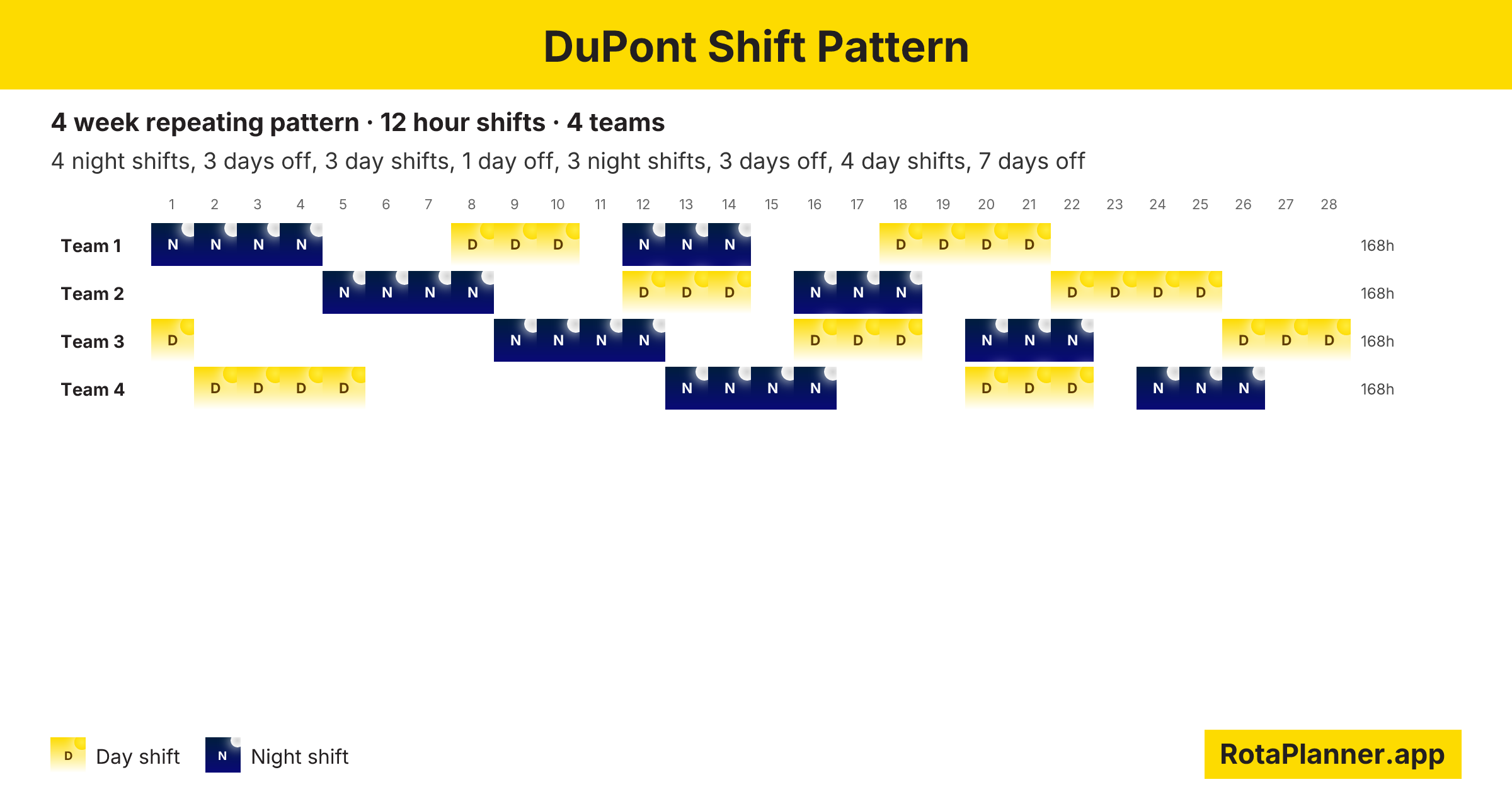
The DuPont shift schedule is a 12-hour rotating shift pattern commonly used in industrial settings. Workers are divided into four crews that each work a specific shift schedule that rotates every 4 weeks.
Fact sheet
| Name | DuPont |
| Family | DuPont |
| Applicability | 24/7 coverage |
| Employees required | 4 |
| Shift length | 12 hours |
| Pattern length | 28 days |
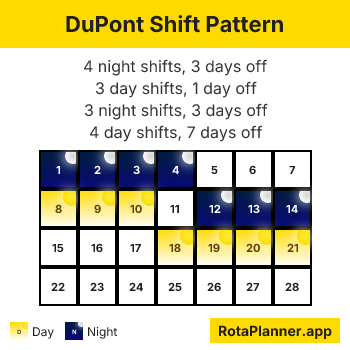
| Pattern | NNNN---DDD-NNN---DDDD------- |
| Pros |
|
| Cons |
|
The breakdown:
- 12-hour shifts (day shift and night shift)
- 4 crews that cover alternating shifts
- Rotating 4-week schedule where each crew works:
- 4 night shifts, 3 days off
- 3 day shifts, 1 day off
- 3 night shifts, 3 days off
- 4 day shifts, 7 days off
Also known as
Since the DuPont company pioneered the rotating 12-hour shift model in the early 1900s, the schedule is commonly referred to by several other names as well:
- Dupont Shift
- Dupont Schedule
- Dupont System
Visualise your pattern
Our calendar tool makes it easy to create a yearly shift schedule based on the {{ name }} pattern. Simply enter your details, and the tool will quickly generate a clear and tidy rota calendar for you.
It will also calculate how many weekends you'll be working, the total hours worked, and display everything in a neat, easy-to-read rota sheet. Use this for for planning and staying organised with your shift schedule.
Define custom pattern
Hours
Shifts
{{ toReadableLetter(letter) }}
| {{ month.name }} | ||||||
| {{ dayName.substring(0,3) }} | ||||||
| {{ day.date }} | ||||||
Turn on 'Background graphics' in the print dialog for colours to show.
Hours & wage calculator
Here's a helpful calculator to work out how many hours you would work per week, month or year in the {{ name }} shift pattern.
You can also use this calculator to work out your weekly and monthly pay for {{ name }} shift schedule.
Options
$
Results
Results recalculate automatically.
| Hours | Pay | |
|---|---|---|
| Per week | {{ hoursPerWeek.toLocaleString() }} | ${{ wagePerWeek.toLocaleString() }} |
| Per month | {{ hoursPerMonth.toLocaleString() }} | ${{ wagePerMonth.toLocaleString() }} |
| Per year | {{ hoursPerYear.toLocaleString() }} | ${{ wagePerYear.toLocaleString() }} |
These values are based on the generated calendar above, therefore the numbers depend heavily on the start date.
Our rota software can do these calculations for you, and more.
Average weekly hours
For a {{ name }} shift pattern, the average weekly working hours is {{ hoursPerWeek.toFixed(1) }} hours.
This assumes you're working {{ hoursPerShift }}-hour shifts.
Average yearly hours
Assuming {{ hoursPerShift }}-hour shifts, your hours per year will be {{ hoursPerYear }} hours using the {{ name }} schedule.
You can use the calculator above to work out your hours for other variations of {{ name }} rota pattern.
How many weekends?
With the {{ name }} shift pattern, you will work at least one day on {{ calendar.weekends.worked }} weekends, of a total of {{ calendar.weekends.total }} weekends in the above calendar year.
So you would work {{ Math.floor(calendar.weekends.worked / calendar.weekends.total * 100) }}% of weekends with the {{ name }} pattern.
Industries
The DuPont shift pattern is commonly used in the following industries:
- Manufacturing
- Chemical plants
- Industrial operations
- Continuous process industries
Hours & Pay calculator 💵
Use this calculator to see how much you should be paid, how much you should expect to earn and the hours you will work.
Assuming the most common 12 hour shifts, you will always work 168 hours every 4 weeks. Which is an average of 42 hours per week.
Options
$
$
Results
Results recalculate automatically.
| Day hours | Night hours | Pay | |
|---|---|---|---|
| Per week | {{ dayHoursPerWeek.toLocaleString() }} | {{ nightHoursPerWeek.toLocaleString() }} | ${{ wagePerWeek.toLocaleString() }} |
| Per month | {{ dayHoursPerMonth.toLocaleString() }} | {{ nightHoursPerMonth.toLocaleString() }} | ${{ wagePerMonth.toLocaleString() }} |
| Per year | {{ dayHoursPerYear.toLocaleString() }} | {{ nightHoursPerYear.toLocaleString() }} | ${{ wagePerYear.toLocaleString() }} |
These are averages and not exact values. The exact values depend on where in the shift pattern you start your calculations from and how long that specific month is.
Our rota software can do these calculations for you, and more.
Workings
With the DuPont shift pattern you will be working on average:
- 3.5 shifts per week
- 15 shifts per month
- 182.5 shifts per year
Here's a 4 weeks of the 'DuPont' shift pattern illustrated.
It contains {{ monthIllustration.dayShifts }} day shifts,
and {{ monthIllustration.nightShifts }} night shifts.
D = Day shift, N = Night shift, O = Off.
D N O
Year
And here is a full year illustrated, it has {{ yearIllustration.dayShifts }} day shifts, and {{ yearIllustration.nightShifts }} night shifts.
D N O
DuPont pros & cons
When considering whether to implement the DuPont shift schedule, companies must weigh the potential benefits and downsides. The rotating 12-hour shifts help reduce fatigue and improve work-life balance, but also require coordination and discipline. Understanding the key pros and cons can inform the decision to transition to this model.
Overall the consensus is the pros tend to outweigh the cons for most industries. The rotations provide a good balance between productivity and employee well-being. However, 12 hour shifts with manual labor can still be physically draining.
Start sharing your shifts with RotaPlanner
today
Try RotaPlanner.app today
14-day free trial.
Fast Email support.
History
The DuPont shift schedule was developed in the early 1900s by the E. I. DuPont de Nemours company as a more humane solution to consistent night shift work in industrial plants.
At the time, many companies used consistent schedules where workers would stay on either day shifts or night shifts for extended periods of time. This was found to lead to issues with fatigue, health problems, safety issues, and personal/family life disruption especially for night workers.
In the early 1900s, DuPont began experimenting with different shift configurations to balance productivity to address these issues. They found the rotating 12-hour shift model helped increase alertness during shifts and allowed adequate breaks between rotations.
Key benefits they noted at the time were:
- Fewer fatigue-related safety issues
- Improved employee morale and engagement
- Better balance between work and personal lives
The company implemented this 12-hour shift model in most plants by the 1930s. The schedule then became more widely adopted by other manufacturing industries over next few decades as awareness of potential benefits increased.

Today, the DuPont model is still recognized as an innovative approach to shift scheduling to reduce safety issues and balance employee wellness needs.
Common Modifications to the DuPont Shift Schedule
While the core structure of the DuPont schedule provides a solid foundation, companies will frequently adapt aspects to better suit their needs.
Shift Length 🕒
- 8 or 10 hour shifts instead of standard 12 hours
- Adjustments to shift start/end times
Rotation Variations 🔄
- Flipping day and night sequences in the 4 weeks
- Changing number of days between rotations
- Modifying sequence of 3 nights vs 2 nights
Team Structures 👥
- More or fewer than 4 teams
- Unbalanced teams to match workload needs
Scheduled Overtime ⏰💼
- Planned OT factored into cycles
- Extra teams handle overtime needs
Experimentation allows companies to optimize the structure, shift lengths, and rotations to suit unique needs. The core ideas of frequent rotation, adequate breaks between shifts, and balance across teams remains central.